
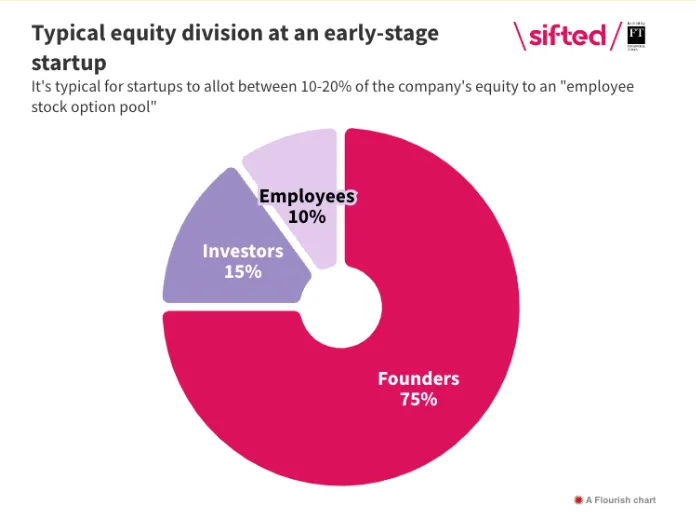
Launching a tech startup is an exhilarating journey fueled by innovation, late-night coding sessions, and grand visions of disrupting the market. In the early stages, founders are often bound by pure trust and shared passion. However, one of the most critical, highly sensitive, and legally complex tasks a founding team must undertake occurs long before product-launch or seed funding: splitting the equity pie.
Improperly allocating equity can doom a promising startup before it even gets off the ground. Deadlocked decision-making, toxic departures, and unvested “dead equity” are among the top reasons tech startups fail. To protect the venture’s longevity, founders must move past emotional handshakes and implement rigorous legal frameworks, dynamic allocation models, and structured vesting schedules.
Here is a comprehensive legal and strategic guide to engineering a bulletproof equity split that safeguards your startup against future founder disputes.
1. The Death of the “Equal Split” Fallacy
The easiest way to divide equity among co-founders is a clean, equal split (e.g., 50/50 for two founders, or 33/33/33 for three). While it feels fair and avoids awkward conversations initially, an equal split is often a structural ticking time bomb for tech startups.
Why Equal Splits Backfire
Asymmetrical Contributions: Over time, it becomes clear that not all founders contribute equally. One founder might quit their day job to work 80 hours a week, while another remains part-time. An equal split breeds immediate resentment in this scenario.
Decision-making Deadlock: A 50/50 split means neither founder has a tie-breaking vote. If a fundamental disagreement arises regarding pivots, hiring, or fundraising, the startup faces operational paralysis.
The Co-Founder Equity Calculator Approach
Instead of guessing, founders should utilize a weighted framework to determine initial equity allocation. The calculation should account for several core variables:
[Technical IP Creation] + [Initial Capital Injection] + [Domain Expertise] + [Primary Execution Risk] = Fair Equity Share
By assigning weights to these components, founding teams can arrive at a data-driven allocation that reflects the actual risk and value each individual brings to the entity.
2. Vesting Schedules: The Ultimate Insurance Policy
Allocating equity is only half the battle; the real legal magic lies in how that equity is earned. Never distribute upfront, unrestricted stock to any founder. Every share allocated to a co-founder must be subject to a strict, legally binding vesting schedule.
Vesting protects the company from a nightmare scenario: a co-founder walking away after three months with 45% of the company’s equity, leaving the remaining founders to do 100% of the work for half the reward.
The Standard Tech Vesting Framework
The industry standard for tech startup vesting is a 4-year schedule with a 1-year cliff.
The 1-Year Cliff: This acts as a probationary milestone. No equity vests until the founder completes exactly 12 months of continuous service. If a founder leaves or is terminated at month 11, they walk away with 0%.
Monthly Linear Vesting: Once the cliff is cleared, the first 25% of the equity is released instantly. The remaining 75% vests incrementally on a monthly basis over the next 36 months ($1/48\text{th}$ of the total grant per month).
| Timeline | Milestone Achievement | Cumulative Equity Earned |
| Months 1–11 | Pre-Cliff Probationary Period | 0% |
| Month 12 | Clearing the 1-Year Cliff | 25% |
| Months 13–48 | Monthly Linear Vesting | Increases by $2.083\%$ every month |
| Month 48 | Fully Vested Milestone | 100% |
Critical Legal Clause: Accelerated Vesting
Founder stock purchase agreements should include acceleration clauses to protect individuals during major corporate shifts:
Single-Trigger Acceleration: Equity immediately vests upon a specific event, typically a change of control (acquisition or merger).
Double-Trigger Acceleration (Highly Recommended): Equity accelerates only if two conditions are met: the company is acquired, and the founder is terminated without cause by the acquiring entity within a specified timeframe. This protects the founder from being pushed out right before a payout.
3. Minimizing Tax Liabilities with the 83(b) Election
For tech founders receiving unvested equity in a newly formed corporation, there is an absolute, non-negotiable tax filing required by the IRS (or regional equivalents): the Section 83(b) Election.
When you receive shares subject to a vesting schedule, the tax authority views vesting milestones as taxable events. Without an 83(b) election, you will owe income tax on the value of the stock as it vests over four years. If your startup’s valuation skyrockets from $0.01 per share to $10.00 per share, you could face a massive tax bill on “phantom income” before you can even sell the stock.
The Solution: Filing an 83(b) election within 30 days of receiving your equity grant tells the government you want to pay all income taxes upfront based on the current fair market value ($0.001 per share). This freezes your tax basis, allowing all future appreciation to be taxed at the much lower long-term capital gains rate upon the actual sale of the company.
4. Legally Resolving Founder Disputes
Even with pristine vesting schedules, interpersonal conflicts, shifting life priorities, and strategic misalignments will happen. To prevent these disputes from fracturing the corporation, the Founder Agreement must contain explicit corporate governance dispute-resolution mechanisms.
Right of First Refusal (ROFR) and Repurchase Options
If a founder decides to exit the company or is terminated, what happens to their unvested and vested shares?
Unvested Shares: These automatically return to the company’s option pool or are cancelled, diluting the remaining founders back up.
Vested Shares: The company must hold a Repurchase Option or Right of First Refusal (ROFR). This legal clause dictates that if an exiting founder wants to sell their vested shares, they must first offer them back to the company or the remaining founders at fair market value before trying to sell them to outside third parties.
Shotgun Clauses and Buy-Sell Agreements
When a terminal deadlock occurs between equal partners, a “Shotgun Clause” can serve as a radical but effective nuclear option. Founder A offers to buy out Founder B at a specific price per share. Founder B then has two choices: accept the offer and walk away, or turn around and buy out Founder A at that exact same price per share. This mandatory reciprocity ensures that the pricing remains completely fair.
Conclusion: Build on Concrete, Not Sand
Equity is the most valuable currency a tech startup possesses. It dictates who controls the company, how profits are distributed, and how attractive the venture appears to venture capitalists and angel investors down the line.
Drafting an equity split requires moving past optimistic assumptions and planning explicitly for the worst-case scenarios: departures, underperformance, and structural gridlock. By anchoring your founding team to data-driven allocation, rigorous vesting schedules, clean tax elections, and airtight dispute-resolution frameworks, you build a firm corporate foundation capable of scaling safely from a garage prototype to an international powerhouse.